
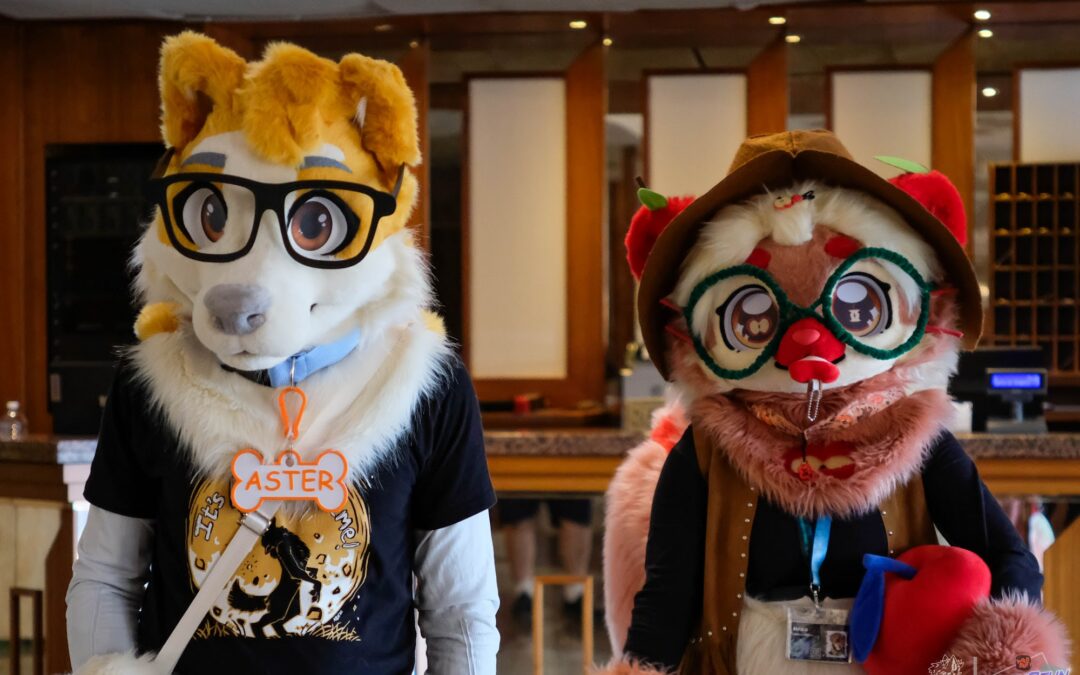
Top photo: two fursuiters at WildOut’s Back2Fun (April 2026); today the Italian fandom has its own multi-day events. Photo: courtesy of WildOut APS (Back2Fun 2026)
Today the Italian furry fandom has conventions with hundreds of attendees, meetups at the main comic fairs and dozens of groups on Telegram and Discord. At the start, though, there were just a few fans of anthropomorphic animals who, in the late 1990s, found out on the Internet that the genre had a name, furry, and that they weren’t the only ones who loved it. This is the story of the Italian furry community, from the newsgroups to the first conventions and today’s social media.
The beginnings: galleries, newsgroups and email (1996-1999)
According to the timeline collected on WikiFur, based on the “Storia del Furry Italiano” (History of Italian Furry) thread written by Contix on Furrymania.it, Italian furries first appeared online in 1996. As the Internet reached people’s homes, artists and fans discovered international galleries such as VCL (Vixen Controlled Library), started posting pictures on newsgroups and got to know each other by email. Among the very first to come together online, the same timeline names Scale, RedFoxy, OpalWeasel (then “Hellenic”), MarkFox and Grifen.
The first meeting in person came in 1999: the so-called first Confuritaly, attended by just three people (Hellenic/OpalWeasel, Scale and Volpike). Since then the in-person meetings have never stopped.
The newsgroup era: FurryITA and the first split
The FurryITA newsgroup was officially founded on 3 January 2000, followed in February by YiffITA; the first moderators were RedFoxy and MarkFox. In 2002 came Xenographia.com, a site hosting the galleries of several Italian artists.
On 19 April 2003 came what WikiFur calls the community’s first split: the Italiafurryart newsgroup, founded by some FurryITA members who preferred to focus on art alone rather than on the more “spiritual” side of furry. Splits and reunions of this kind would happen again in the years that followed.
2004-2006: portals and forums, and the birth of Furry Italia
In spring 2004 the Furry.it portal was launched, the first to collect articles, news and reviews about the furry world in Italian. Around the same time RedFoxy and other fans founded FurryItalia, which WikiFur lists as the first Italian furry forum: this site celebrates its birthday on 21 July 2004.
In 2006 the Furry.it domain expired and the portal was abandoned. On 24 May 2006 Contix and Cringer founded Furrymania.it, a portal with a built-in forum focused mainly on the cultural side of furry, while FurryItalia went on covering the side more tied to lifestyle. For some years the community gathered mostly on these two forums, and the old newsgroups were gradually abandoned.
Furmeets at the comic fairs: Romics and Lucca
From the very beginning, people mostly met at comic fairs. On 24 November 2001, during the first edition of Romics in Rome, the first official furmeet among FurryITA members took place, with four attendees (MarkFox, Scale, Contix and Araldo). The second meetup, again at Romics, on 26 October 2002, drew about ten people. Then came a picnic at the Monte Gelato waterfalls on 1 May 2003, remembered as the last meeting of the original FurryITA group while it was still together, and a final furmeet at Romics on 9 October 2004.
On 3 November 2007 the users of Furrymania.it held their first official meetup at Lucca Comics & Games. From then on Lucca became a regular fixture, with around fifteen people attending on average. In summer 2011 Furrymania organised its first meetup in Rome that wasn’t tied to a fair, with 18 people signed up and a visit to the Bioparco zoo.
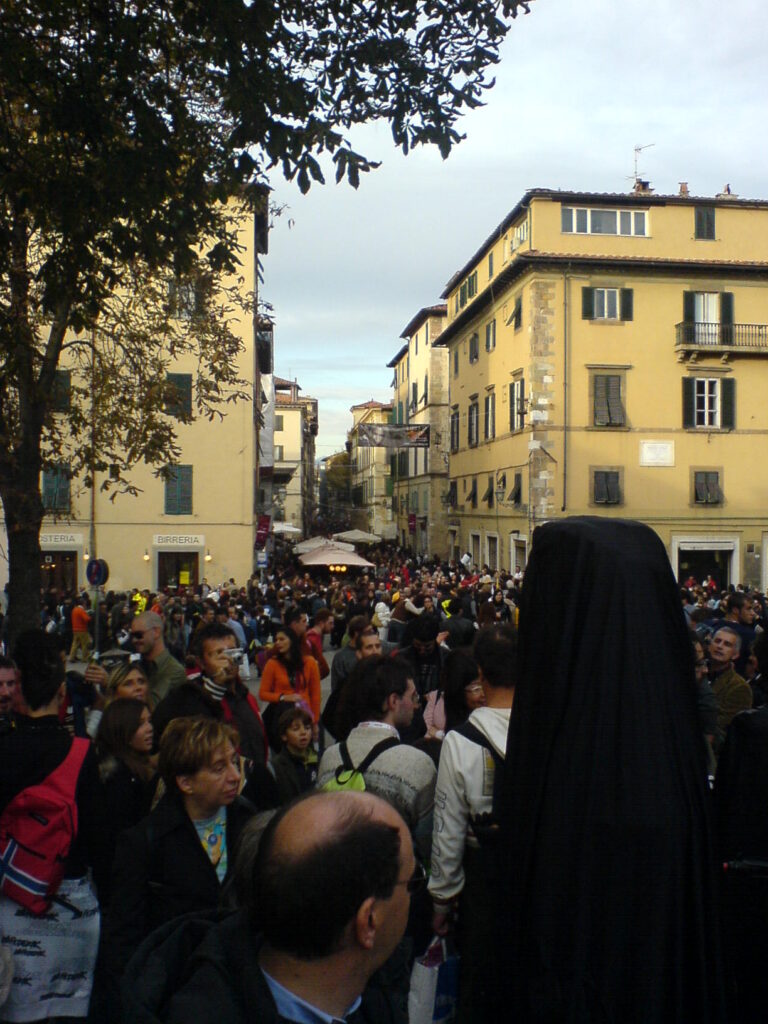
The crowd in Piazzale Umberto I on the last day of Lucca Comics & Games 2007, the edition of Furrymania.it's first official meetup. Photo: Dzag, CC BY-SA 3.0, via Wikimedia Commons
Meetups at fairs still happen today. The FurryDen project, started in 2017, organised the “Lucca Furries & Games” meetups (documented in 2017, 2018, 2019 and 2022) and get-togethers at the Festival del Fumetto in Novegro and in Turin; today newer groups organise meetups in Lucca, at Romics, Novegro and Napoli Comicon, and at many fairs in the North-East.
From fair to convention: Zampacon, Italian Fur Haven and Furizon
Until 2012 Italian furries met mostly at fairs or abroad: according to WikiFur, Italian attendance at Eurofurence, the big European convention, had never been more than eleven people. Things changed with Zampacon, considered the first Italian furry convention: the first edition was held in Bologna from 29 December 2012 to 1 January 2013, with 31 attendees, panels, drawing contests and screenings.
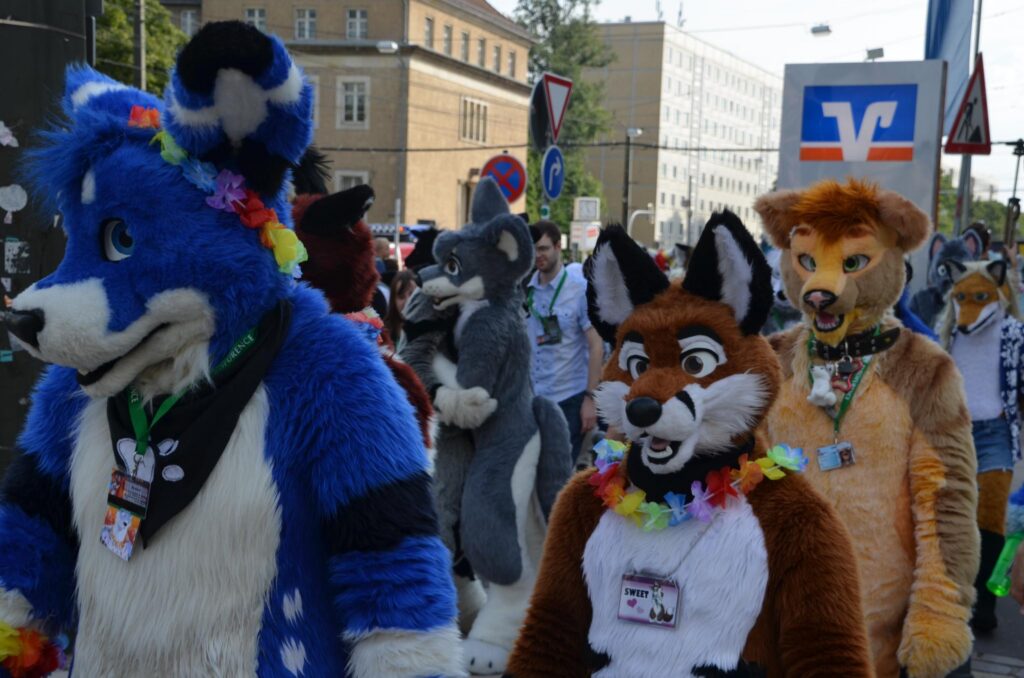
The Eurofurence 19 fursuit parade in Magdeburg (2013): before Zampacon, many Italian furries could only go to conventions abroad. Photo: Torsten Maue, CC BY-SA 2.0, via Wikimedia Commons
Zampacon grew every year: 39 attendees in Rimini in 2013, 54 in Bellaria-Igea Marina in 2014 and 58 in 2015, when it organised what WikiFur describes as the first authorised furry street parade in Italy, covered by two local newspapers. The convention announced that it was closing down on 13 December 2017.
Italian Fur Haven also started in 2014: its first event, from 1 to 4 May 2014 at a venue in the province of Reggio Emilia, drew about 60 attendees, some of them from abroad. The project came to an end, however, as early as late 2014.
At the end of 2014 Silverwolf and Rigel founded Furizon, which held its first furmeet from 30 April to 3 May 2015 in Trentino, with plenty of nature and outdoor activities. In 2018 the non-profit association APS Furizon was set up, and in 2022 the event became a full hotel convention, with 135 attendees. The numbers have grown every year since: according to WikiFur, 214 attendees in 2023, 269 in 2024, 391 in 2025 (the first edition at the Devero Hotel in Cavenago di Brianza, just outside Milan) and 496 in 2026, with the “Polaris” edition. In the autumn there is also the Furizon Riverside furmeet.
In recent years other associations running multi-day events have appeared. One is WildOut APS, founded in 2024 and based in Lucca, a grassroots group that aims to grow the way Furizon did. Its first event, Back2Fun, was held on 25 and 26 April 2026 in Pieve di Cento (Bologna) with 83 attendees, and Wild in the Woods is planned for April 2027 at the same venue.
Social networks, Telegram and Discord
Facebook arrived in the second half of the 2000s: lots of online groups appeared and, as WikiFur notes, the community broke up into many small communities. Regional groups appeared too. One documented example is SPQF, founded in Rome in November 2015, which in its first two years organised dozens of furmeets and built ties with groups such as Campaniafurs and Lombardianfurs.
In recent years the community has moved mostly to Telegram and Discord, as well as Instagram, TikTok and X. Furry Italia has its own Telegram channel, and the groups that run events, from Furizon to PowsUp! and Nexus Fur Events, use dedicated chats and channels to coordinate registrations, meetups and group photos. We cover these new groups in a separate article.
Who are the Italian furries?
A 2013 survey run on Furrymania.it, with 103 responses and reported by WikiFur, described a young community (the most common age group was 19-24), concentrated mainly in the North (Emilia-Romagna, Veneto and Piedmont), with Campania the best-represented region in the South. The most common fursona species were wolf, dragon, fox and cat. The data are old by now and come from a small sample, but they are among the few figures available on the Italian fandom of those years.
From three people in 1999 to almost five hundred attendees at a single convention in 2026: the Italian fandom grew thanks to people who wanted to meet each other.
If you have memories, photos or documents from the early years of the Italian fandom, such as meetups, sites that no longer exist or newsgroups, write to us: we’d like to preserve this history, which belongs to the whole community.
Sources
- WikiFur (it): Community furry italiana (timeline based on the “Storia del Furry Italiano” thread by Contix on Furrymania.it)
- WikiFur (it): Convention
- WikiFur (it): Zampacon
- WikiFur (en): Italian Fur Haven
- WikiFur (en): Furizon and WikiFur (it): Furizon
- APS Furizon official website
- WikiFur (it): SPQF
- FurryDen: events archive and Storia del Furry Fandom (in Italian)
- Furry Italia on Telegram