
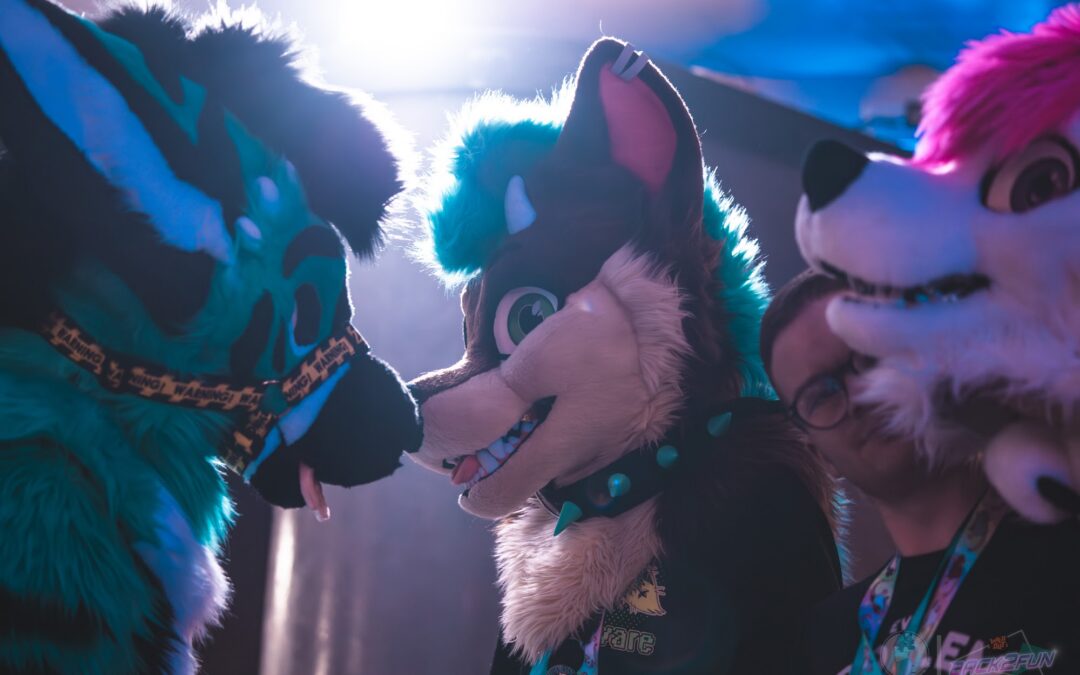
Top photo: three fursuiters posing at WildOut’s Back2Fun (April 2026). Photo: courtesy of WildOut APS (Back2Fun 2026)
Fursona, partial, headless lounge, YCH… Anyone coming to the furry fandom for the first time, whether a new fan, a curious parent or a journalist working on a story, soon runs into a lot of jargon, acronyms and made-up words. In this furry glossary we have collected the most common terms, grouped by topic and explained simply.
The basics
- Furry: someone who is a fan of anthropomorphic animals, meaning animals with human characteristics (they walk on two legs, talk, feel emotions). The word refers to the people and sometimes also to the characters or the works.
- Fandom: the community of fans that gathers around a shared interest. The furry fandom is the community of furries.
- Anthropomorphic / anthro: an animal with human traits. “Anthro” is the short form, widely used in the community.
- Fursona: a blend of furry and persona, the anthropomorphic animal character a furry creates to represent themselves in the community. According to Furscience’s research, about 95% of furries have one.
- Species: the animal species of a fursona: wolf, fox, dragon, cat, but also invented creatures. According to Furscience’s 2020 survey the most common are the wolf, the dragon and the fox.
- Hybrid: a character that mixes two or more species, for example a “wolf-fox”.
- Closed species: a species invented by an artist or a group, which you can use for your own character only with its creator’s permission.
- Character sheet / ref sheet: a character’s reference sheet, with drawings showing it from several angles along with its colours, markings and details. Artists use it to draw the character correctly.
- Greymuzzle: a long-time furry, usually an older one.
- Therian: a person who feels a spiritual or identity connection with an animal. It’s a separate phenomenon from the furry fandom and, according to Furscience, concerns a small share (about 10%) of furries.
Art and commissions
- Commission: a piece of work, usually a drawing, ordered from and paid to an artist. A good part of the fandom’s creative economy runs on commissions.
- Artist and TOS: artists often publish their Terms of Service (TOS), meaning their working conditions: prices, turnaround times, what they will and won’t draw.
- YCH: short for Your Character Here, a drawing with a set pose and scene into which the artist puts the buyer’s character.
- Adopt / adoptable: an original character designed and put up for sale by an artist. Whoever “adopts” it becomes its owner and can use it as their own.
- Art trade: an exchange of drawings between two artists: I draw your character, you draw mine.
- Toony: a cartoon style, with simple, rounded shapes and exaggerated expressions, as in animated cartoons.
- Kemono: from the Japanese for “beast”, a style inspired by anime and manga, with soft lines and big eyes. Kemonomimi, on the other hand, are human characters with only animal ears and tail.
- Feral: an animal character drawn in a more natural form, on four legs, even if it may talk or think like a human.
- Badge: a tag with the name and a drawing of your character, often commissioned from an artist and worn around the neck at conventions. Not to be confused with the event’s registration badge.
- SFW / NSFW: Safe For Work / Not Safe For Work, which tell you whether content is suitable for everyone or meant for adults only. Serious platforms and conventions keep the two apart.
Fursuits and costumes
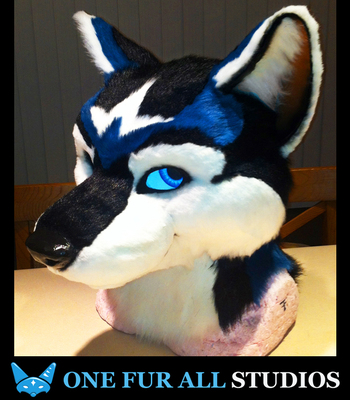
A wolf partial, a fursuit made up of head, paws and tail, built by the maker One Fur All (photo: Hopesa, CC BY-SA 3.0)
- Fursuit: a mascot costume portraying a character, usually the wearer’s own fursona. According to Furscience, only a minority of furries own one.
- Fursuiter: someone who wears a fursuit.
- Full suit / fullsuit: the complete costume, covering the whole body.
- Partial: a costume made of only some parts, usually head, paws (for the hands) and tail. It’s often the first costume for people getting into fursuiting.
- Digitigrade / plantigrade: two ways of building a fursuit’s legs. Digitigrade legs use padding to imitate the hind leg of animals that walk on their toes (like dogs and cats); plantigrade legs follow the natural shape of a human leg.
- Feetpaws / handpaws: the “paws” worn on the feet and hands.
- Toony / realistic suit: fursuits also differ in style, either cartoonish and colourful or as close as possible to the real animal.
- Maker: a craftsperson or studio that builds fursuits on commission.
- Handler: the person who accompanies a fursuiter, guiding them (you can’t see much from inside a costume), bringing them water and helping them take breaks. At conventions this is a very important role.
- Headless lounge: a private room where fursuiters can take off their costume heads, cool down and rest away from the public. People always try not to break the character’s illusion, especially in front of children.
- Fursuit parade: the parade of fursuits, one of the most photographed moments of a convention.
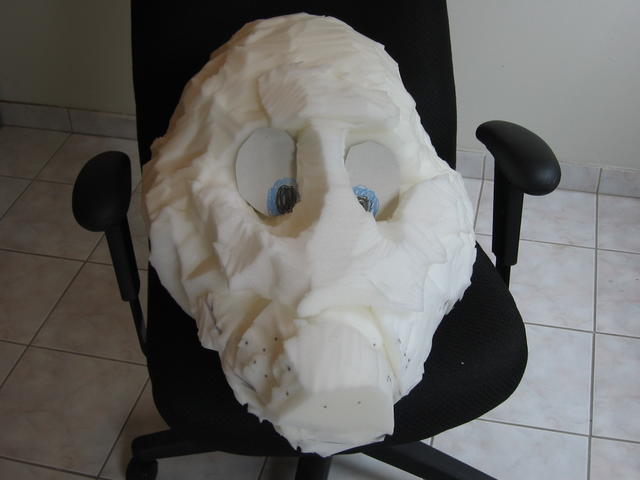
The foam base of a fursuit head, before it is covered in faux fur (photo: Rat at WikiFur, CC BY-SA 3.0)
Events and conventions
- Furcon / con: short for furry convention, an event lasting several days, usually in a hotel or convention centre, with panels, workshops, shows and a market. Among the largest are Anthrocon and Midwest FurFest in the United States and Eurofurence in Germany.
- Furmeet / meet: an informal meet-up between furries, such as an afternoon in the park, a dinner or a museum visit. It’s the easiest way to get to know the local community.
- Con suite: a convention’s hospitality room, where you’ll find snacks and drinks and people stop for a chat.
- Dealers’ den: the convention market, where artists and craftspeople sell prints, badges, accessories and handmade goods.
- Artist alley: an area, often more informal than the dealers’ den, where artists draw live and take commissions.
- Art show: the convention’s art exhibition, often with auctions of the works on display.
- Charity auction: almost every con raises money for a charity, often one connected to animal protection.
- Conbook: the convention’s official booklet, with the programme, maps, rules and illustrations by artists.
- Badge (registration): the pass that identifies people registered for the event. Those who choose the higher registration tiers (sponsor, supersponsor) give the con extra financial support and get small extras in return.
- GoH: Guest of Honor, the convention’s guest of honour, often a well-known artist or author.
- Panel: a session or talk on a specific topic, from building fursuits to digital drawing.
- Dead dog party: the party once the convention is over, to say goodbye before heading home.
- Con crud: the cold (or worse) that many people take home after days spent among thousands of others. Washing your hands often helps.
- Staff / volunteer: conventions are run largely by volunteers, who take care of everything from registration to security.
Online and community
- Fur Affinity: one of the online art galleries the fandom uses most, where artists and writers post their work.
- WikiFur: the collaborative encyclopedia of the furry world.
- Telegram and Discord: the messaging apps furry communities, including Italian ones, use most today to organise meet-ups and keep in touch.
- VRChat: a virtual reality platform popular with furries, who use it with avatars of their characters. There are also fully virtual conventions.
- Furry art / furry music: general terms for works created by members of the fandom or about anthropomorphic characters.
- OwO / UwU: emoticon faces used jokingly online to express surprise or affection. They have become a meme outside the fandom too.
- Boop: an affectionate tap on the nose. People do it to a fursuit’s muzzle too, gently and after asking first.
- Yiff: slang for sexual content. We mention it because you may come across it: it’s a part of the fandom reserved for adults and kept separate from public activities.
A little etiquette
There are also a few common-sense rules every furry knows: always ask first before touching or hugging a fursuiter, don’t take their head off or ask who is “inside”, respect other people’s characters and work (never use someone’s art without permission or pass it off as your own) and, of course, have fun.
Is a word missing? Write to us and we’ll add it to the glossary.
To learn more about the fandom’s history and culture, read our article What is the furry fandom? Origins, history and culture.