
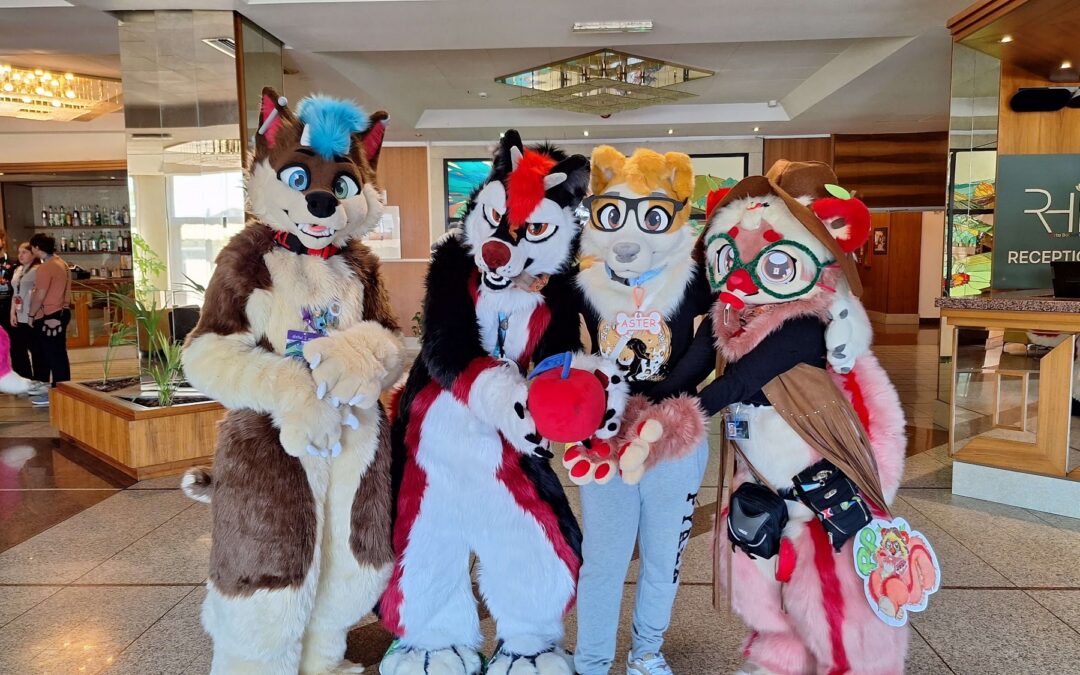
Top photo: a group of fursuiters at WildOut’s Back2Fun (April 2026). Photo: courtesy of WildOut APS (Back2Fun 2026)
Foxes who draw, wolves who play music, dragons who raise money for animal shelters. If you have heard about furries in a TV segment or a meme, you probably came away with a partial picture, or a completely wrong one. In this article we describe the furry fandom starting from the data. It’s an international community of fans of anthropomorphic animal characters, meaning animals with human traits, which grew out of the fanzines of the 1980s and now fills convention centres with tens of thousands of people.
A simple definition
The word furry (from fur) describes people who are interested in anthropomorphic animals: characters who walk, talk, feel emotions and live through stories as humans would. You already know plenty of them, from the foxes and rabbits of classic animation to the heroes of many video games and comics. The fandom is the community that has formed around this interest.
According to Furscience, the academic research team of the International Anthropomorphic Research Project (IARP), the term furry describes “a diverse community of fans, artists, writers, gamers, and role players”. Everyone experiences it in their own way: some draw, some write stories, some build costumes and some simply spend time with friends who share the same interests.
The origins: fanzines, science fiction and a convention in California
The fandom has its roots in American science fiction and comics conventions. As early as 1976 Ken Fletcher and Reed Waller started Vootie, an amateur press association (a kind of collective amateur magazine) devoted to drawings of animals. According to the account given by Wikipedia, in 1980 a drawing from Steve Gallacci’s Albedo Anthropomorphics sparked a discussion at a science fiction convention that helped give rise to the term “furry”, and the phrase furry fandom was already appearing in fanzines by 1983.
The first issue of Rowrbrazzle, founded by Marc Schirmeister, came out in February 1984. The fandom historian Fred Patten considered it one of the “first clear signs” of an independent furry fandom, separate from science fiction and comics fandom.
At the end of the 1980s Mark Merlino and Rod O’Riley, who were already running “furry parties” at science fiction conventions on the West Coast, took the next step. On 21 and 22 January 1989, at the Holiday Inn Bristol Plaza in Costa Mesa, California, they held ConFurence 0, considered the first furry convention in history. There were 65 attendees. A year later, at the first “official” edition, there were already 130.
The arrival of the Internet
The Internet changed things. In November 1990 the Usenet newsgroup alt.fan.furry was created, and the same year saw the launch of FurryMUCK, a text-based virtual world where users could play their own characters. For the first time, fans living in different cities and countries could talk every day, swap drawings and stories, and organise themselves.
Since then the community has followed the evolution of the web: forums and mailing lists, then online art galleries such as Fur Affinity, the collaborative encyclopedia WikiFur, social networks, Discord servers, Telegram groups and, more recently, virtual reality spaces. There are even fully virtual conventions: according to Wikipedia, Furality had about 21,000 registrations in 2024.
The fursona: a character of your own
Almost all furries have a fursona (a blend of furry and persona), an anthropomorphic animal character created to represent themselves within the community. According to Professor Sharon E. Roberts of the University of Waterloo, one of the Furscience researchers, about 95% of furries have a fursona.
A fursona can be an idealised version of oneself, a character with traits its owner recognises in themselves, or simply an avatar to use online. As for species, in Furscience’s 2020 international online survey the most common single species was the wolf (20.7%), followed by the dragon (16.0%) and the fox (15.8%). Hybrids (14.0%) and “other” species (23.9%) are also very common.
Art, writing, music
Much of the fandom revolves around creativity, and above all illustration. A great many furries draw, and many others commission work from artists in the community, so a small economy of independent creators has grown up. Styles range from realistic to cartoon (toony) to kemono, which is inspired by Japanese animation.
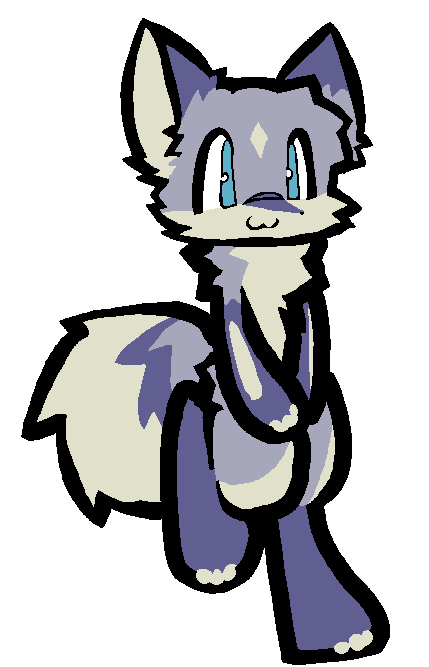
An example of cartoon-style furry art: a grey anthropomorphic fox with blue eyes (illustration: M3gg1rl1ng, CC BY 4.0)
Besides drawing there’s fiction (short stories, novels, webcomics), role-play, animation, crafts and music. Conventions often host concerts, DJ sets and dance nights, and some musicians release songs about their fursona or about life in the fandom.
Fursuits: the best-known costumes (though not the most common)
The image most associated with furries is the fursuit, a mascot costume that portrays the wearer’s character. They are often very elaborate handmade pieces, built by specialist makers or by fans themselves, and they can be complete (full suits) or partial (head, paws and tail).
Not everyone has one, though. According to Furscience, in the 2011 international survey only about 10-15% of furries owned a full fursuit and about 25% a partial one, while almost 50% would have liked to own one. Among convention-goers the percentages are higher: in a study carried out at Anthrocon in 2018, 45.8% of attendees owned a full or partial fursuit. The researchers explain this with two factors: people who own a costume are more drawn to events where they can show it off, and people who can afford a fursuit (which is expensive) can often afford the trip as well.
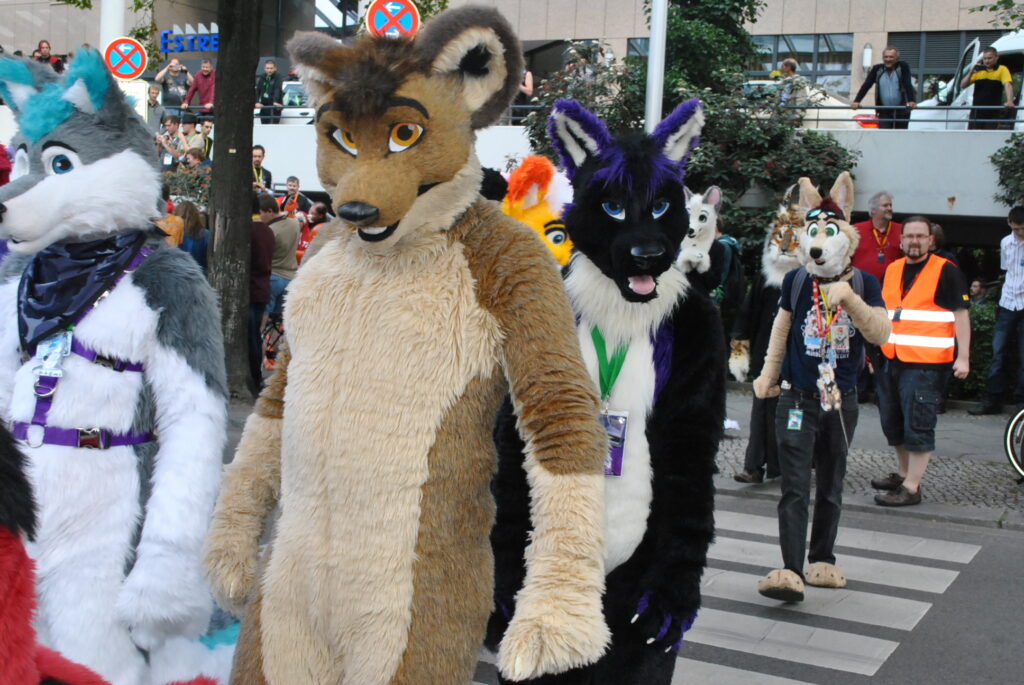
Fursuiters at Eurofurence 2014, the main European furry convention (photo: Douglas Muth, CC BY-SA 2.0)
Conventions: from 65 people to tens of thousands
Furcons are the fandom’s main gatherings. They last three or four days, with panels, workshops, art shows, artists’ markets (the dealers’ den), performances, games, themed evenings and the fursuit parade. Today there are dozens of them around the world, and some are very large:
- Anthrocon (Pittsburgh, USA) recorded 18,357 attendees in 2025;
- Midwest FurFest (Chicago area, USA) passed 16,900 attendees in 2025, according to figures reported by Wikipedia;
- Eurofurence, founded in Germany in 1995 with just 19 attendees, is now held at the CCH in Hamburg and welcomed more than six thousand people in 2025.
Alongside the big events there are smaller conventions and furmeets, informal meet-ups in a park, a pizzeria or a museum. For anyone who wants to get to know their local community, they are often the first and most relaxed point of contact.
A community that gives to charity
The media rarely talk about charity. Almost every convention picks a charity, often one linked to animal welfare, and raises money through auctions, donations and dedicated events. A few verified examples:
- Midwest FurFest 2025 raised $151,517 for MCP Rescue + Outreach; in 2023 the total was $185,758 for Live Like Roo;
- Anthrocon 2025 raised more than $87,000 for Nose 2 Tail Cat Rescue, a cat shelter in Pennsylvania;
- Eurofurence 29 (Hamburg, September 2025) donated €51,081.88 to the Hamburger Tierschutzverein von 1841, the city’s animal protection society.
According to Midwest FurFest, since the first convention in 1989 the furry community has raised a total of more than $3 million for charities around the world.
Who are furries? What the data say
Since 2011 the International Anthropomorphic Research Project, a group of psychologists and sociologists from several universities, has studied the fandom with questionnaires given online and at conventions. The results, published on the Furscience website, contradict many stereotypes:
- Age: furries are mostly young. Most adults are in their early twenties (roughly 20 to 25) and, according to Furscience, about 75% are under 25; the average age of adults in the various samples ranges from about 23 to 31.
- Gender and orientation: most study participants identify as male, but the fandom is far more varied than the general population. According to Roberts, more than 70% of furries identify as LGBTQ+ and more than 25% have a gender-nonconforming identity. Many see the fandom as a safe space where they can be themselves.
- Well-being: according to Furscience, furries do not differ significantly from a control group in self-esteem, psychological well-being and satisfaction with their relationships.
- Motivation: the reason most often given for being part of the fandom is a sense of belonging, along with entertainment and a chance to get away from daily routine.
One finding is less positive: according to Roberts, furries are bullied almost twice as often as non-furries. That’s one more reason to describe the fandom accurately.
Myths to debunk
“Furries think they are animals”
No. As Sharon E. Roberts puts it: “Furries don’t identify as animals; they identify with animals”. A fursona is a character, like an avatar in a video game or a stage name. Furscience estimates that a small part of the fandom (about 10%) describes itself as therian, meaning they feel a spiritual connection with an animal. That’s a separate phenomenon, and the vast majority of furries are not part of it.
“Schools put out litter boxes for furry students”
This is a hoax that has done the rounds on social media several times. Roberts, who has attended dozens of conventions in several countries, says she has never seen a litter box at any of them and calls the rumour pure disinformation.
“It’s all about sex”
As in any community of adults, there is content for an adult audience, but reducing the fandom to that is misleading. According to the studies, people come to the fandom mainly out of a need for friendship and belonging. Conventions are public events with codes of conduct, street parades and activities suitable for families too.
“All furries have a fursuit”
As we have seen, only a minority own a full costume. A great many furries take part in the fandom by drawing, writing or chatting online, without a costume.
The furry fandom is a community of people who share a creative passion and who, around characters with ears and tails, have found a place where they feel welcome.
If you’re curious, ask questions and get to know the people. Here on FurryItalia we have been covering the Italian community, its events and its people since 2004. If some of the words seemed strange, have a look at our furry glossary.

A group of fursuiters posing at WildOut's Back2Fun (April 2026). Photo: courtesy of WildOut APS (Back2Fun 2026)
Sources
- Furscience: What’s a Furry?
- Furscience: 1.1 Age and Ageism
- Furscience: 2.8 Fursuits
- Furscience: 3.1 Species Popularity
- Sharon E. Roberts, “What are ‘furries?'”, The Conversation, 7 November 2022
- Wikipedia: Furry fandom
- Wikipedia: ConFurence
- Wikipedia: Rowrbrazzle
- Wikipedia: Eurofurence
- Anthrocon: Anthrocon 2025 Convention Wrap-Up
- Midwest FurFest: Charity History
- Hamburger Tierschutzverein: “Thank you furry much! Riesenspenden bei der Eurofurence”