
This sheet sums up what a journalist should know before writing about furries: who they are, where the fandom comes from, what data exist and where they come from. Every figure links to its source.
A one-sentence definition
The furry fandom is the community of people interested in anthropomorphic animals, meaning animal characters with human traits: they walk, talk and have feelings. According to Furscience, the research group of the International Anthropomorphic Research Project (IARP), the word furry describes “a diverse community of fans, artists, writers, gamers and role-players”.
Being a furry is a shared interest, like science fiction, anime or role-playing games. It is not a sexual orientation, a diagnosis or a religion.
The fursona
Almost every furry has a fursona (from furry + persona), an anthropomorphic animal character that represents them in the community, much like an avatar or a stage name. According to Sharon E. Roberts, a professor at the University of Waterloo and a Furscience researcher, about 95% of furries have one. In Furscience’s 2020 online survey the most common species was the wolf (20.7%), followed by the dragon (16.0%) and the fox (15.8%).
The fursuit
A fursuit is a mascot-like costume of a person’s character. It is the fandom’s most photographed image, yet few people own one: according to Furscience, only about 10-15% of furries own a full fursuit and about 25% a partial one. The share is higher among convention-goers: in a study at Anthrocon 2018, 45.8% of attendees had a full or partial fursuit. Many furries take part in the fandom only by drawing, writing, gaming or chatting online.
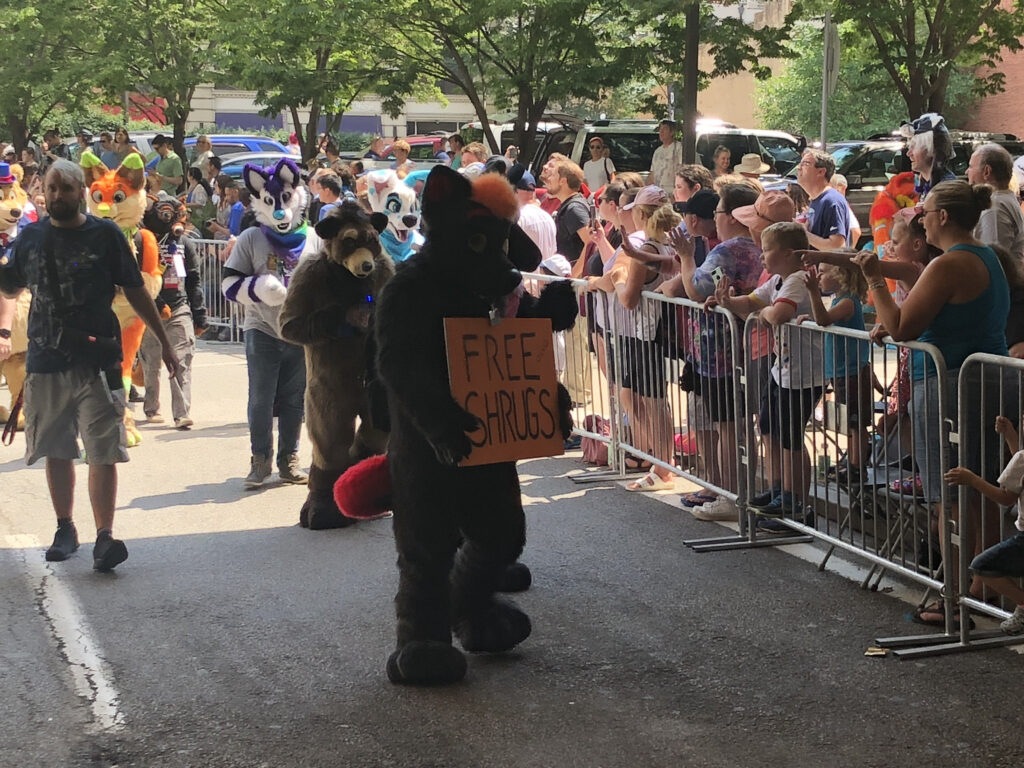
The Anthrocon 2019 fursuit parade through the streets of Pittsburgh, with spectators behind the barriers. Photo: Douglas Muth, CC BY-SA 2.0, via Wikimedia Commons.
Origins at a glance
- 1976-1983: Ken Fletcher and Reed Waller start Vootie, an amateur magazine about cartoon animals; according to Wikipedia, the term furry fandom appears in fanzines as early as 1983.
- 1984: Rowrbrazzle is launched, seen as one of the first signs of a furry fandom separate from science fiction and comics fandom.
- January 1989: ConFurence 0, considered the first furry convention, is held in Costa Mesa, California, with 65 attendees.
- November 1990: the Usenet newsgroup alt.fan.furry is created, and the internet becomes the community’s main meeting place (Wikipedia).
- Today: the fandom lives on social networks, Discord, Telegram, online art galleries and virtual reality spaces. The virtual convention Furality recorded about 21,000 registrations in 2024 (Wikipedia).
Key figures: what the studies say
The main source is the International Anthropomorphic Research Project, a group of psychologists and sociologists from several universities who have studied the fandom since 2011 through online and convention surveys, publishing their results on furscience.com. The data come from volunteer samples, not from a census. For ethical reasons the studies only involve adults, so there are no direct data on furries under 18 (Furscience).
| Topic | Finding | Source |
|---|---|---|
| Age | Almost 75% of furries are under 25; the average age ranges from 24.0 to 27.1 in convention samples and from 23.3 to 31.2 in online samples | Furscience 1.1 |
| Gender | At Anthrocon 2018: 65.7% men, 20.9% women; about 12.2% fall into the broad “transgender” category, more than 20 times the rate in the general population. In the 2021-2022 studies, between a quarter and a third of furries did not identify primarily as cisgender | Furscience 1.3 |
| Orientation | More than 70% of furries identify as LGBTQ+ | Roberts, The Conversation |
| Motivations | The reasons given most often are a sense of belonging, entertainment and escape from routine | Furscience |
| Wellbeing | Taking part in the fandom is associated with higher self-esteem and life satisfaction and with a more stable, coherent identity | Furscience |
| Bullying | Furries are bullied almost twice as often as non-furries | Roberts, The Conversation |
| Therians | Between 5% and 20% of participants, depending on the sample (7% in the most recent one), identify as therian, which is a separate phenomenon from being a furry | Furscience 7.1 |
Conventions in numbers
Furry conventions (furcons) usually last three to five days and include panels, workshops, art shows and artists’ markets, performances and the fursuit parade. Some recent figures:
| Convention | Location | Attendees | Source |
|---|---|---|---|
| Anthrocon 2026 | Pittsburgh (USA) | 20,618 | Anthrocon on X |
| Midwest FurFest 2025 | Rosemont, Illinois (USA) | 16,925 | Wikipedia |
| Eurofurence 30 (2026) | Hamburg (Germany) | 9,139 | Wikipedia |
Charity: the figures
Nearly every convention supports a charity, often an animal-related one, through art auctions, raffles and shows. Some documented results:
- Midwest FurFest: $151,517 in 2025 for MCP Rescue + Outreach; $135,946 in 2024 for The Street Dog Coalition; $185,758 in 2023 for Live Like Roo.
- Anthrocon 2025: more than $87,000 for a cat shelter in Pennsylvania. For 2026, Anthrocon announced on X that it had raised more than $86,000.
- Eurofurence 29 (Hamburg, 2025): €51,081.88 for the Hamburger Tierschutzverein von 1841. For Eurofurence 30 (2026) the chosen charity is the Seehundstation Friedrichskoog, a seal rescue centre; at the time of writing the final amount had not been published.
- Overall: according to Midwest FurFest, the furry community has raised more than 3 million dollars for charities around the world since 1989.
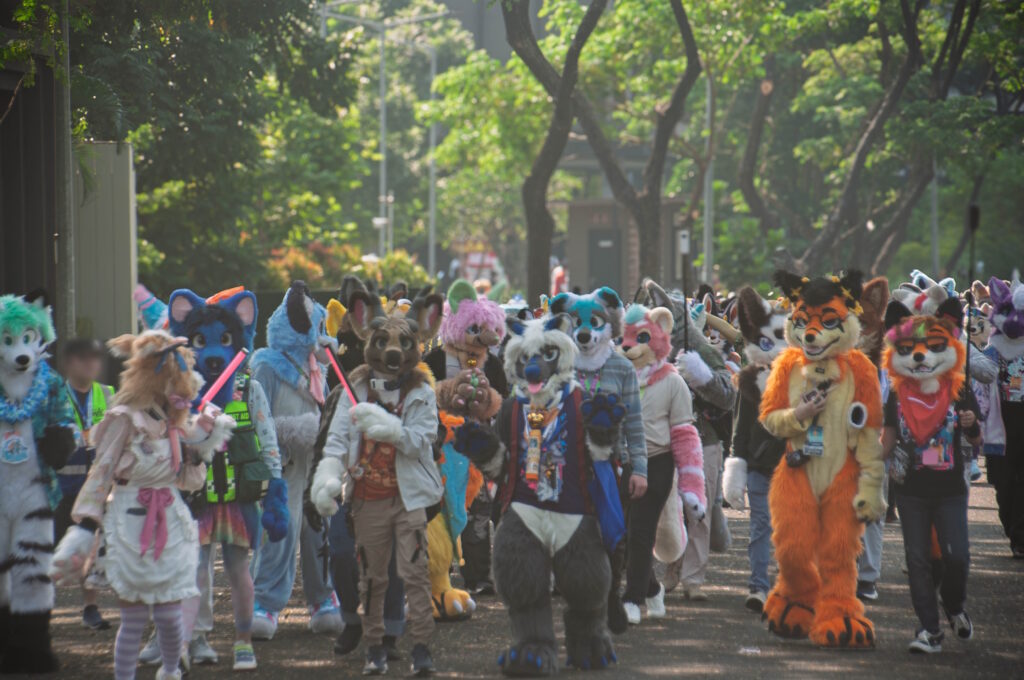
The fursuit parade at the Indonesia Weekend Anthro Gathering (IWAG), July 2026: the fandom has spread all over the world. Photo: Ryjz, CC BY 4.0, via Wikimedia Commons.
What about Italy?
As far as we know, there are no reliable estimates of the number of furries in Italy: Furscience does not publish figures for individual European countries. So please don’t report numbers that aren’t documented. This is what the sources show:
- Furry Italia has been online since 21 July 2004.
- According to WikiFur, the Italian community’s first official convention was Zampacon (in Italian), held in Bologna from 29 December 2012 to 1 January 2013.
- Furizon, a non-profit association, has organised an annual convention in northern Italy since 2015 (in 2026 at Cavenago di Brianza, 2-5 June) and a smaller autumn event, Furizon Riverside, capped at 130 places (FurryGuides).
- Nexus Fur Events, founded in 2022, organises furry meets in parks and at comic fairs in north-eastern Italy.
For the history of the fandom, see also our article What is the furry fandom. More information is in the frequently asked questions and myths and on the sources, studies and useful contacts page. Back to the press kit index.
Sources
- Furscience: What’s a Furry?
- Furscience: 1.1 Age and Ageism
- Furscience: 1.3 Sex, Gender, and Gender Identity
- Furscience: 2.8 Fursuits
- Furscience: 3.1 Species Popularity
- Furscience: 7.1 Therians: Prevalence
- Sharon E. Roberts, “What are ‘furries?'”, The Conversation, 7 November 2022
- Wikipedia: Furry fandom
- Wikipedia: ConFurence
- Wikipedia: Rowrbrazzle
- Wikipedia: Midwest FurFest
- Wikipedia: Eurofurence
- Anthrocon on X: Anthrocon 2026 figures
- Anthrocon: Anthrocon 2025 Convention Wrap-Up
- Midwest FurFest: Charity History
- Hamburger Tierschutzverein: “Thank you furry much!” (in German)
- Eurofurence 30: Charity
- WikiFur: Zampacon (in Italian)
- FurryGuides: Furizon Riverside 2026
- Nexus Fur Events
- Wikimedia Commons: Anthrocon Fursuit Parade (2019)
- Wikimedia Commons: Parade Fursuit IWAG 2026

